From Manila I received a link from the Indonesian Jesuit Greg Soetomo. It was related to the review of my book on Catholics in Independent Indonesia, 1945-2010, published in his journal Asia Pacific Mission Studies, vol 2 (2020). This journal is the continuation of the East Asian Pastoral Review. The review was written by Paul Steffen, teaching in Rome at the Urbaniana University.
It was nice to see how Steffen presented the whole structure of the book (as third volume of the history since 1800) in a well written, informative article, with some personal additions.
Thank you Paul (and Greg).
Greg also published an article in this issue of the journal: Maturing as believers through Interreligious Encounters. He studied Christian theology in various places and countries, but wrote his Ph.D at the Islamic University of Jakarta (UIN Syarif Hidataullah) on the history of Islam by Marshall Hodgson. His mission is not conversion, but maturing belief. Evangelization, proclamation of the Gospel are not the first words he would like to use for his way of life and worldview. In the end he formulates from the document Nostra Aetate (of the Vatican II Council of 1965) three questions: 1) Can structures (Church as religious system) save? 2) Is Muhammad a prophet? 3) Is Qur'an the Divine Word?
Dialogue between religions had in the 1960s the same dynamic as ecumenical dialogue: ultimately with a goal that Christianity should be united in one church organization. Therefore divided Reformed Protestantism started with the World Council of Churches. Finally this institutional unity was not reached and for most more or less religious people nowadays it is no longer an ideal. The churches are human creations and not divine per se. The same can be said for religions: let them focus on encounters where personal belief can grow.
About the Qur'an as Divine Word, Wilfred Cantwell Smith already formulated that this depends on the reader/hearer: when it is used as motivation for hatred, religious crimes and terrorism, it is definitely not functioning as divine word. But when it gives inspiration for good acts, solace in troubles, it can be seen as a divine gift.
zondag 19 april 2020
maandag 13 april 2020
Resurrection and hijrah
At the occasion of Easter, my former student Syafaatun al-Mirzanah, now a very active professor of interreligious thinking at the UIN, Universitas Islan Negeri of Yogyakarta, sent me an article publisehd already in 2014 (19 April) in the English language Jakarta Post. It is a column on the meaning of Easter from a Muslim viewpoint. First she refers to differences amongst Christians: followers of Bultmann will not easily receive the story as 'historical event'. She also has a reference to Qor'an 4:158 ('Allah raised him up to himself') that usually is read as such that Jesus straight from the cross was taken to heaven, without dying. In this case Jesus should be 'resurrected' some 36 hours earlier than in the Christian story.
Syafa makes a comparison with the life of Muhammad, who was also rejected by most of his people in Mecca and with a small number of his faithfull Muslims moved to another place, 400 km north, Yathrib, later called Medina, or city of the prophet. About one year after he had to flee from threats in Mecca, moved to Yathrib in the hijra or the migration, Muhammad could stand the attack of people from that place who wanted to kill him in Yahtrib/Medina at the battle of Badr. But there God helped him and he received a military victory. After Easter also Jesus became the Lord of Glory and so Muhammad after the hijra.
This is quite a different interpretation from Snouck Hurgronje who claimed that while moving from Mecca to Medina, Muhammad put off his robe of being a prophet and became a politician (see also the title of the book by Montgomery Watt: Muhammad, Prophet and Statesman).
In the vision of Syafaatun, Muhammad in Medina was a further development of his prophetic role. It was not all smooth and easy, like also in the last chapters of the gospels and the book of Acts of the Apostles we read often about faith and courage, but also doubt and incertainty. But the hijra was the further development and now often in glory.
Syafa makes a comparison with the life of Muhammad, who was also rejected by most of his people in Mecca and with a small number of his faithfull Muslims moved to another place, 400 km north, Yathrib, later called Medina, or city of the prophet. About one year after he had to flee from threats in Mecca, moved to Yathrib in the hijra or the migration, Muhammad could stand the attack of people from that place who wanted to kill him in Yahtrib/Medina at the battle of Badr. But there God helped him and he received a military victory. After Easter also Jesus became the Lord of Glory and so Muhammad after the hijra.
This is quite a different interpretation from Snouck Hurgronje who claimed that while moving from Mecca to Medina, Muhammad put off his robe of being a prophet and became a politician (see also the title of the book by Montgomery Watt: Muhammad, Prophet and Statesman).
In the vision of Syafaatun, Muhammad in Medina was a further development of his prophetic role. It was not all smooth and easy, like also in the last chapters of the gospels and the book of Acts of the Apostles we read often about faith and courage, but also doubt and incertainty. But the hijra was the further development and now often in glory.
zondag 12 april 2020
Saints used to fight fundamentalists
George Quinn is a lecturer of Javanese at ANU, Canberra. 12-13 December last year he was at the farewell seminar of Willem van der mlen and held a nice speech on the modern production of Javanese literature. He was more or less the defender of what seems to be a lost cause: interest for the use of Javanese in public for modern people.
I had already bought his last book on perhaps another lost case: abangan religiosity, especially found nowadays in the places of pilgrimage. Only now I had the opportunity to read the book in full: Bandit Saints of Java, How Java's eccentric Saints are challenging fundamentalist Islam in modern Indonesia (Burrough on the Hill, Leicestershire UK: 2019, 432 pages). The book has an extension of its title on the front page: George Quinn meets the wacky figures from Java's past, whose mysterious tombs have an enduring hold over the Muslims of Indonesia. I bought the book at the Periplus Book Shop in Jakarta, Senayan Plaza.
Quinn is tall, 194 m. and so quite visible amidst the crowds of the pilgrimages centres he loves. The book is an extended Tour of the Wali Songo, the Nine Muslim Saints of about 1500 in Java. It begins with Sunan Bonang and Sunan Kalijaga, ends with the grave of Sunan Bayat. All major figures are discussed: Siti Jenar who died like al-Hallaj, Jumadil Kubra who was perhaps the first. The only lady perhaps is Sharifa Ambami (268), unless we talk about a Puteri Cina. And perhaps no 10 must be Abdurrahman Wahid whose grave is still quite recent. The stories of the official guides at the graves (juru kunci) are mixed with the classical Javanese texts, modern practise in the time of 'religious and spiritual tourism'.
At various places in this book the schism between santre and abangan is discussed. The cultural change in Indonesia after Communism was banned in 1965-6 and more rigorous Islam was seen as a strong vaccin against Communism, and abused as a movement to destroy the validity of abangan Islam. Thousands and thousands of new teachers of religion, educated to promote strict Islam received an increase in hours of teaching and public respects. But according to Quinn this not only ended in the rise of fundamentalist Islam (Madinier and Bruinessen), but the popularity of graves, pilgrimages continued and increased even thanks to more money, the impossibility to go on the hajj (restricted to 200.000 per year and a waiting list of some twenty years!)
The writings about the Wali Songo can be very sophisticated: the Suluk Malang Sumirang (about 1600! On pages 162-8) is a very keen defence of what now is Islam Nusantara, a plea in favour of a distinct Indonesian interpretation of Islam and rejection of privileges for Arabic.
Quinn wrote a challenging, sometimes very funny book, sometimes with direct quotes from his field notes, historic wisdom. One should hope that he is not fighting for a lost cause.
I had already bought his last book on perhaps another lost case: abangan religiosity, especially found nowadays in the places of pilgrimage. Only now I had the opportunity to read the book in full: Bandit Saints of Java, How Java's eccentric Saints are challenging fundamentalist Islam in modern Indonesia (Burrough on the Hill, Leicestershire UK: 2019, 432 pages). The book has an extension of its title on the front page: George Quinn meets the wacky figures from Java's past, whose mysterious tombs have an enduring hold over the Muslims of Indonesia. I bought the book at the Periplus Book Shop in Jakarta, Senayan Plaza.
Quinn is tall, 194 m. and so quite visible amidst the crowds of the pilgrimages centres he loves. The book is an extended Tour of the Wali Songo, the Nine Muslim Saints of about 1500 in Java. It begins with Sunan Bonang and Sunan Kalijaga, ends with the grave of Sunan Bayat. All major figures are discussed: Siti Jenar who died like al-Hallaj, Jumadil Kubra who was perhaps the first. The only lady perhaps is Sharifa Ambami (268), unless we talk about a Puteri Cina. And perhaps no 10 must be Abdurrahman Wahid whose grave is still quite recent. The stories of the official guides at the graves (juru kunci) are mixed with the classical Javanese texts, modern practise in the time of 'religious and spiritual tourism'.
At various places in this book the schism between santre and abangan is discussed. The cultural change in Indonesia after Communism was banned in 1965-6 and more rigorous Islam was seen as a strong vaccin against Communism, and abused as a movement to destroy the validity of abangan Islam. Thousands and thousands of new teachers of religion, educated to promote strict Islam received an increase in hours of teaching and public respects. But according to Quinn this not only ended in the rise of fundamentalist Islam (Madinier and Bruinessen), but the popularity of graves, pilgrimages continued and increased even thanks to more money, the impossibility to go on the hajj (restricted to 200.000 per year and a waiting list of some twenty years!)
The writings about the Wali Songo can be very sophisticated: the Suluk Malang Sumirang (about 1600! On pages 162-8) is a very keen defence of what now is Islam Nusantara, a plea in favour of a distinct Indonesian interpretation of Islam and rejection of privileges for Arabic.
Quinn wrote a challenging, sometimes very funny book, sometimes with direct quotes from his field notes, historic wisdom. One should hope that he is not fighting for a lost cause.
donderdag 26 maart 2020
Back to Indonesia: the kris of Diponegoro
Prince Diponegoro (1785-1855) was a member of the Yogyakarta court and candidate for the succession to the throne of the sultanate in the early 1820s, but not selected. He started a campaign to become still the Sultan and this was the beginning of the Java Wat (1825-1830). Diponegoro was supported by some Muslim leaders: the most important being Kiai Modjo and Ali Basah Abdul Mustapa Sentot. In 1830 Diponegoro had the idea that he could have a meeting about conditions for negotiations, but was arrested and sent in exile to Manado and later to Makassar.
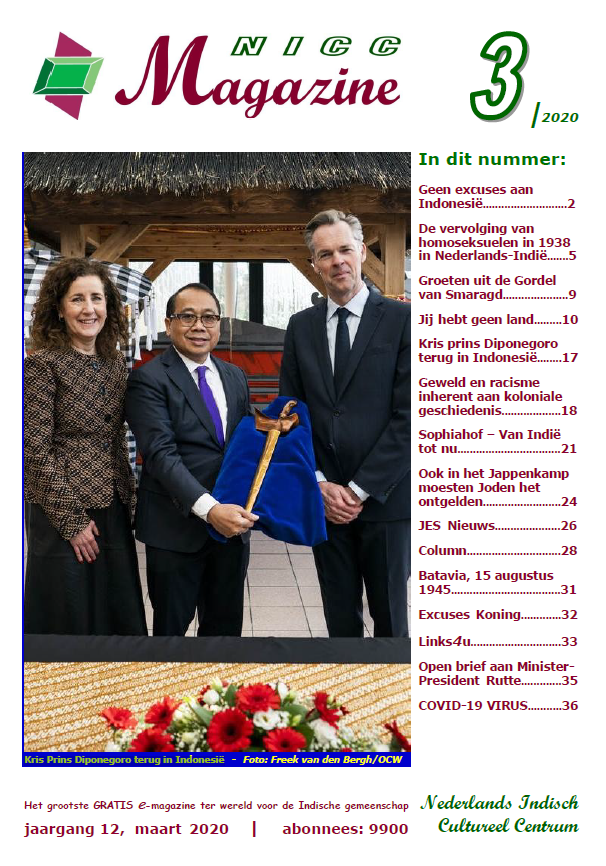
The dagger or keris of Diponegoro, a costly weapon with golden decorations, was presented to the Dutch King in 1831 and kept in the Anthropological Museum of Leiden. Now there is a policy of returning precious pieces of art that were robbed from colonial subject to the new countries (to be found on the internet under https://www.trouw.nl/cultuur-media/ex-kolonies-kunnen-roofkunst-terugkrijgen-met-nieuwe-leidraad~bec7741d/). The keris of Diponegoro is one of the first to be restituted under this regulation.
Above a drawing of Diponegoro with his kris and the issue of the magazine of the Eurasian people in the Netherlands with Dutch minister of Education and Culture (left) and the Indonesian Ambassador in the Hague, I Gusti Agung Wesaka Puja (centre) during the ceremony in early March 2020.
The dagger or keris of Diponegoro, a costly weapon with golden decorations, was presented to the Dutch King in 1831 and kept in the Anthropological Museum of Leiden. Now there is a policy of returning precious pieces of art that were robbed from colonial subject to the new countries (to be found on the internet under https://www.trouw.nl/cultuur-media/ex-kolonies-kunnen-roofkunst-terugkrijgen-met-nieuwe-leidraad~bec7741d/). The keris of Diponegoro is one of the first to be restituted under this regulation.
Above a drawing of Diponegoro with his kris and the issue of the magazine of the Eurasian people in the Netherlands with Dutch minister of Education and Culture (left) and the Indonesian Ambassador in the Hague, I Gusti Agung Wesaka Puja (centre) during the ceremony in early March 2020.woensdag 25 maart 2020
Nyepi in Bali in a time of corona-virus
Nyepi is a day of rest, calm down, silence. Just one day per year in Bali, not unlike ramadan, but that is one month and every evening crowded, festive even. But in day-time also meditation, forgiving. Elga Sarapung sent me a nice wish or nyepi:
Nyepi of Bali gves now a special flavour to the social lockdown: few social contacts, staying in the house us much as possible. No libraries open, no restaurants, cinemas, mosques and churches closed down. No choir rehearsals, no concerts. Easter without the Passion music of Bach. Some very serious communal Nyepi. But we still could make a nice walk along the canal in the cold but sunny weather of what we consider as a quiet spring! Happy claming down!
woensdag 18 maart 2020
A new Balinese Muslim myth about seven founders, Wali Pitu, and a war about the Prambanan Mosque
Syaifuddin Zuhri has a name quite similar to the famous writer and pesantren leader Saifuddin Zuhri, father of Minister of Religion Lukman Hakim Saifuddin. But he is younger and probably has no connections to the two others mentioned above. Due to the corona virus, sitting at home, without access to the books of the libraries in Utrecht and Leiden, I read two articles, available through the internet.
The most fascinating was published in 2013 in Indonesia and the Malay World (vol 41:1-13): Inventing Balinese Muslim Sainthood. Parallel to the Nine Founders of Islam in Java, the Wali Songo, Zuhri wrote about seven graves in Bali, signs of a long history of Islam. The first is in Gèlgèl, where in 1380 a Muslim trader arrived and was given an area to stay. A second arrived in 1580 in Klungkung, in 1609 there was a report of a few Muslims from Goa, Buginese who settled in Jembrana. In 1992 a tradition of Wali Pitu was invented/created by one Toyib Zaen Arifin (1925-2000), who had a pesantren in Sidoarjo, but also spread the Qadiriya tariqa and the Manaqib of Abdulqadir Jaelani to Bali. He heard voices, hâtif, about 1. a Muslim grave close to Tanah Lot; 2. in Bedugul, 3-5 in Karangasem; 6. Singaraja (of a Chinese Muslim; 7. of someone of Arab descent in Loloan.
Above here the seven Muslims buried in a maqam in Bali, with bottom left Toyib Zaen Arifin who discovered the graves. - There is a modest number of activities close to the simple graves, nothing similar to the crowds in Surabaya, Ampel, but maybe it will rise again. Of the 3,5 million citizens of Bali 10% is Muslim.
A second article by Syaifuddin Zuhri is about the 'infiltration of Salafi Muslims in moderate mosques'. The case here is about Masjid al-Muttaqun in Prambanan, Central Java. It was built in the 1950s at the initiative of the court of the Sunan of Solo and led by Muhammadiyah people. Due to the earthquake of 26 May 2006 the Aisyah School next to the mosque was destroyed. PKS leader Hidayat Nur Wahid, born in Prambanan and chair of parliament since 2004 took this opportunity to have a PKS individual to be nominated a major leader of the mosque, the prevent rebuilding of the Aisyiyah school and instead to extend the existing mosque into an Islamic Centre, financed by gifts from Kuwait. Muhammadiyah teachers were given higher salaries at the PKS Islamic Centre. Its leader received a free ticker for the haj pilgrimage. The Muhammadiyah also took action: national leaders like Amin Rais and Chamamah Suratno were present at ceremonies and an action of bersih-bersih (to clean the institutions from Salafi/PKS influence) had some success. After some time the full board of the Muttaqun mosque had become united as Muhammadiyah Members.
The dominant colour of the Muttaqun mosque in Prambanan in now brown (PKS colour), while Nahdlatul Ulama mosques are mostly white and Muhammadiyah prefers green.
The father of Hidayat Nur Wahid was a staunch Muhammadiyah leader, but his son, although educated in Muhammadiyah schools, before going to Gontor and then to Medina, got the 'tarbiyah virus' and became a prominent leader of PKS. Story to be continued!
(On Al-Muttaqun from Kees van Dijk & Nico Kaptein (eds), Islam, Politics and Change, Leiden Univ. Press. 2016, 79-100.)
The most fascinating was published in 2013 in Indonesia and the Malay World (vol 41:1-13): Inventing Balinese Muslim Sainthood. Parallel to the Nine Founders of Islam in Java, the Wali Songo, Zuhri wrote about seven graves in Bali, signs of a long history of Islam. The first is in Gèlgèl, where in 1380 a Muslim trader arrived and was given an area to stay. A second arrived in 1580 in Klungkung, in 1609 there was a report of a few Muslims from Goa, Buginese who settled in Jembrana. In 1992 a tradition of Wali Pitu was invented/created by one Toyib Zaen Arifin (1925-2000), who had a pesantren in Sidoarjo, but also spread the Qadiriya tariqa and the Manaqib of Abdulqadir Jaelani to Bali. He heard voices, hâtif, about 1. a Muslim grave close to Tanah Lot; 2. in Bedugul, 3-5 in Karangasem; 6. Singaraja (of a Chinese Muslim; 7. of someone of Arab descent in Loloan.
Above here the seven Muslims buried in a maqam in Bali, with bottom left Toyib Zaen Arifin who discovered the graves. - There is a modest number of activities close to the simple graves, nothing similar to the crowds in Surabaya, Ampel, but maybe it will rise again. Of the 3,5 million citizens of Bali 10% is Muslim.
A second article by Syaifuddin Zuhri is about the 'infiltration of Salafi Muslims in moderate mosques'. The case here is about Masjid al-Muttaqun in Prambanan, Central Java. It was built in the 1950s at the initiative of the court of the Sunan of Solo and led by Muhammadiyah people. Due to the earthquake of 26 May 2006 the Aisyah School next to the mosque was destroyed. PKS leader Hidayat Nur Wahid, born in Prambanan and chair of parliament since 2004 took this opportunity to have a PKS individual to be nominated a major leader of the mosque, the prevent rebuilding of the Aisyiyah school and instead to extend the existing mosque into an Islamic Centre, financed by gifts from Kuwait. Muhammadiyah teachers were given higher salaries at the PKS Islamic Centre. Its leader received a free ticker for the haj pilgrimage. The Muhammadiyah also took action: national leaders like Amin Rais and Chamamah Suratno were present at ceremonies and an action of bersih-bersih (to clean the institutions from Salafi/PKS influence) had some success. After some time the full board of the Muttaqun mosque had become united as Muhammadiyah Members.
The dominant colour of the Muttaqun mosque in Prambanan in now brown (PKS colour), while Nahdlatul Ulama mosques are mostly white and Muhammadiyah prefers green.
The father of Hidayat Nur Wahid was a staunch Muhammadiyah leader, but his son, although educated in Muhammadiyah schools, before going to Gontor and then to Medina, got the 'tarbiyah virus' and became a prominent leader of PKS. Story to be continued!
(On Al-Muttaqun from Kees van Dijk & Nico Kaptein (eds), Islam, Politics and Change, Leiden Univ. Press. 2016, 79-100.)
dinsdag 10 maart 2020
Dutch Royal couple in Jakarta: no apology for bad illusions
The Dutch King Willem Alexander and Queen Maxima are today in Jakarta for a lunch with President Jokowi in Bogor. The newspapers bring the news that Alexander has asked forgiveness and spoke about apology for the extreme violence by the Dutch against the young Indonesian Republic in 1945-1949. This was the first time that such excuses were uttered. Then King repeated his conviction that 1945 was the year of Indepence of Indonesia and he expressed his congratulations for the 75th anniversary of Independence this year. But it was still not an overall excuse for the warfare, the military actions against Indonesian Independence. The Dutch cherished in 1945-9 an impossible colonial illusion about the need for Indonesians to be steered, instructed and led by the Dutch administration in order to reach adulthood as a state. The colonial dream was continued, notwithstanding the fact that the Netherlands had lost independence between 1940 and 1945 and recently had received freedom again through help of American, Canadian, British, French and Polish soldiers.
Not everybody in the Netherlands was happy with this royal statement. Eurasians claimed that they had suffered much violence from Indonesian fighters for independence. Others saw this excuse for extreme violence as not enough.
Klaas van Berkel was today also in the media. He retired as professor of modern history in Groningen. His latest book is given the title: Een en al illusies (Only illusions) because he considerd the study of culture as a study of its illusions, dreams, impossible goals. Some illusions are functional: they may stimulate people to reach at least part of their ideals. But other ideals are only ways to cover up bad practices.
Karl Marx wrote about religion as the opium of the poor, the soothening product to create dreams. Jan van Baal, governor of colonial administration in Papua and anthropologist wrote about the three dreams: art, sport and religion. The colonial dream is rather an ideology, a system of thinking or political and social manipulation to sell bad practice overseas. Nevertheless, Professor van Berkel defined illusion as bouwsteen van de beschaving, illusion as the cornerstone of civilisation.
Not everybody in the Netherlands was happy with this royal statement. Eurasians claimed that they had suffered much violence from Indonesian fighters for independence. Others saw this excuse for extreme violence as not enough.
Klaas van Berkel was today also in the media. He retired as professor of modern history in Groningen. His latest book is given the title: Een en al illusies (Only illusions) because he considerd the study of culture as a study of its illusions, dreams, impossible goals. Some illusions are functional: they may stimulate people to reach at least part of their ideals. But other ideals are only ways to cover up bad practices.
Karl Marx wrote about religion as the opium of the poor, the soothening product to create dreams. Jan van Baal, governor of colonial administration in Papua and anthropologist wrote about the three dreams: art, sport and religion. The colonial dream is rather an ideology, a system of thinking or political and social manipulation to sell bad practice overseas. Nevertheless, Professor van Berkel defined illusion as bouwsteen van de beschaving, illusion as the cornerstone of civilisation.
Abonneren op:
Posts (Atom)